Where deals actually leak.
Your team is working hard. The pipeline still feels like guesswork. I find where revenue gets stuck between your people, your process and your systems, fix it, and hand you back a sales operation your team can actually run.
Last updated
- Lead
- Qualified No criteria
- Demo
- Proposal Goes quiet
- Won
- Retained Forgotten
Taking on three businesses this quarter. SA, UK and US.
You’ve outgrown the informal approach. You haven’t replaced it yet.
You’re hiring, or you already have people in seats. The leads are real. And yet none of it feels as solid as it should. A pipeline you don’t quite trust. A forecast that’s really just a confident guess. That gap isn’t a motivation problem, and it isn’t a talent problem.
0 of 6 ticked Two or more is the point where we should talk.
It’s rarely a people problem. Almost always, it’s a process problem.
That’s two. Two isn’t a bad quarter, it’s a pattern — and a pattern has a place it starts. The Leak Cost Check will tell you which one is yours, and what it costs.
I have a mildly annoying habit when someone shows me their sales process.
I start asking questions. Usually by question five, we’ve found the leak.
- Q1Who owns the next step on this deal?A name is a good answer. “Whoever picks it up” means nobody, and nobody is the most expensive person on the team.
- Q2What has to happen before it moves to the next stage?If the answer describes how the call went rather than what the buyer did, the stage is measuring optimism. So is the forecast you’re planning cash against.
- Q3That proposal went out eleven days ago. What happens now?Usually nothing, until someone remembers. Silence isn’t a no, but nobody has decided what day three, day ten and day thirty are supposed to look like.
- Q4Where is any of this written down?Your best salesperson has a method. It lives in their head, not in the CRM, and it leaves with them. Everyone hired after them starts again from nothing.
- Q5And what happens if nobody does it?The answer that decides all the others. If it’s “nothing”, you don’t have a process, you have a preference. Preferences lose to a busy week.
None of these are hard questions. They are just questions nobody in the business has had to answer out loud. When the answers come slowly, that is not a discipline problem in your team. It is a design problem in the process, and that is the part I fix.
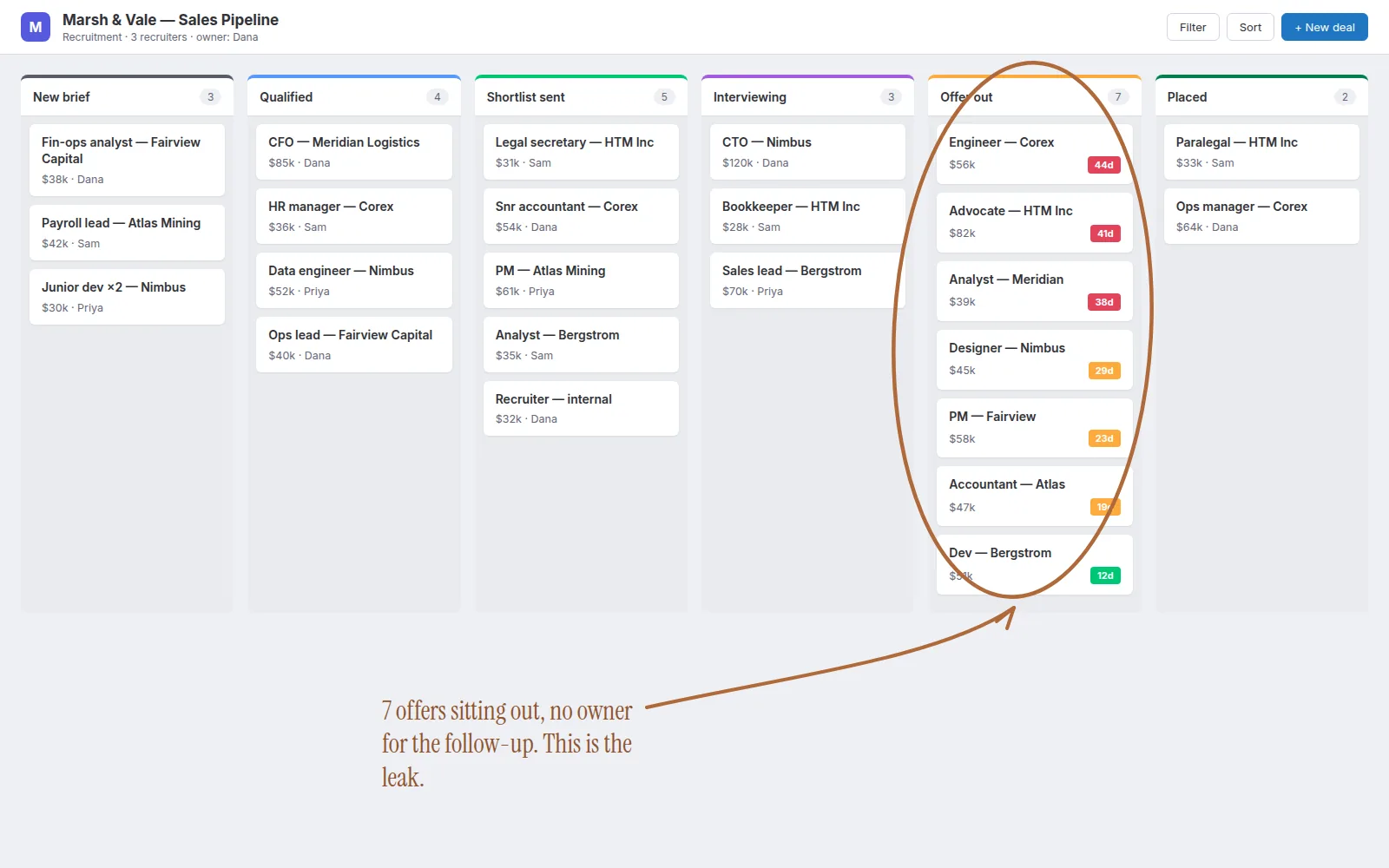
The Pipeline Leak Map.
Deals don’t get lost to competitors nearly as often as they get lost to silence. There are five places silence happens. Most businesses have two.
- Leak 01 · QualifiedNo criteriaMost pipelines never define “qualified”. So everything downstream is built on a guess.Proved in Case 01 →
- Leak 02 · Demo → ProposalMoves on feelingsA deal advances because the call felt good, not because the buyer gave you evidence.Proved in Case 02 →
- Leak 03 · ProposalGoes quietProposal goes out, then silence. No system means nobody notices in time.Proved in Case 04 →
- Leak 04 · WonNobody owns the handoverThe client said yes. Then sales, onboarding and delivery each re-explain them from scratch.Proved in Case 03 →
- Leak 05 · RetainedForgot the cheapest revenueThe step most processes skip, and the revenue that costs least to win.Proved in Case 01 →
Which two are yours?
Ten questions about how your deals actually behave. Four numbers put a figure on it.
Your result is on screen straight away, no email needed. No call booked, nothing to install.

Four businesses that felt exactly like yours does.
Different industries, same underlying problem every time: nothing broken, nothing built. Here’s what was actually wrong, and what changed once it was fixed.
We win the business. Then the admin drags it out for weeks.Recognised by BrightRock · Top New Business, 2021 Underwriting turnaround40–90 days → ~1 month Read the case 02 / 04 Legal staffing & recruitment · California, USA
Everything works, because one person is personally doing it.Pitch to placement16% → 30%+ Read the case 03 / 04 SaaS & payment solutions · South Africa, Namibia & Botswana
I can see revenue in the pipeline. I can’t see it on month-end itself.Application processing2–4 months → 1–4 weeks Read the case 04 / 04 Education & training · admissions
Leads come in, get called, and go quiet.Later consulted on their student recruitment incentives Enquiry-to-enrolment10% → 40% Read the case
// If one of them sounds like yours, tell me which one and I’ll tell you where I’d look first. All four in full →
I don’t sell you the fix until I know what’s broken.
Sometimes the answer is CRM. Sometimes follow-up. Sometimes qualification, reporting, or management. Sometimes there isn’t a pipeline problem worth paying me to solve, and I’ll say so on the first call.
- The Leak Cost CheckFreeabout 90 seconds
Ten questions name which of the five places is yours, or whether it is the way in before them. Four numbers put a figure on it, beside the fixes that match, priced. No email needed.
Take the Leak Cost Check - Template pack & CRM checklistFreedo it yourself
The stage definitions, follow-up sequence and CRM setup I’d start with. No charge.
Get the templates - Find the leak$1,5507 days
For when you can’t name it. Your own CRM and last ninety days of deals, read properly. It goes toward the fixes you start inside 30 days.
How Find the leak works - What I fixfrom $700most take 1 week
Sixteen problems, each a flat price inside a written cap. Tick the ones you recognise; the call confirms the cause and can’t raise the price.
See the sixteen, priced - Built together3 fixesfrom spreadsheets
Set up my CRM, then the alerts and the playbook on top. Nothing shared is paid for twice.
Price all three together - Keep it running$1,700 / momonth to month after three
The weekly pipeline review, the reporting kept true, the CRM kept clean. Only once something is live.
How Keep it running works
Running it thirty days after handover, or another thirty days at no charge.
If there’s no lead flow yet, or what you want is someone to run the team day to day, I’m the wrong first call.
Meet Chan

Chanel Greeff · Founder, The Pipeline Fixer
LinkedIn →
Most people see sales as conversations. I see the infrastructure behind them.
I don’t believe businesses have sales problems. They have systems problems that show up as sales problems. A lead goes cold because nobody owns the next step. A good salesperson underperforms because the process changes every week. The forecast is wrong because the CRM was built to collect data rather than help anyone sell.
I’ve spent the last decade doing this inside businesses rather than advising from outside them. I’ve built CRMs from scratch, written playbooks teams actually opened twice, hired and coached salespeople, and rebuilt pipelines that were losing deals nobody had noticed losing. Mostly in financial services, payments, recruitment and education, plus several years alongside law firm owners in the United States.
I’ve built this from zero inside a payments company and a US staffing firm, and was promoted to run the team that had to use it. That’s why adoption is the job, not the afterthought.
Growth rarely breaks because people stop caring. It breaks because nobody designed the system they’re expected to work inside. That’s the work: find where revenue leaks, cut the complexity, build a process your team will actually use, and leave.
Her systems were never just administrative requirements; they were genuine assets that made the sales process smoother and more effective for everyone using them.
The method is the same everywhere. The leaks have local names.
Tool-agnostic by design. I build in what you already run.
Most of the time the tool isn’t the problem, and replacing it is the most expensive way to find that out. Where something new would genuinely help, I’ll tell you what and why. The decision is always yours.

Two links above can earn me something: monday.com is an affiliate link and Wispr Flow a referral link. Sign up through either and I may earn a fee or a reward, at no extra cost to you. Neither changes what I recommend — every tool here is one I use, and the recommendation was written before the link was. What those links track.
Recognise your business in any of this?
The first call is free. Tell me how deals actually move through your business and I’ll tell you where I think it’s leaking, whether or not you ever work with me. If you want that confirmed with evidence rather than taken on my word, that’s Find the leak, $1,550.
Things I notice in sales teams.
Questions I get asked often enough to be worth writing the answer down properly. Fifteen so far.
- Where do sales pipelines actually leak?In five places, and almost never to a competitor. Most businesses have two.
- What should sales pipeline stages actually measure?Buyer evidence, not salesperson optimism. And deals have to be able to move back.
- Why do deals go quiet after a proposal?Because the proposal was the last thing anyone owned. Nobody asked what happens next.
- Why does your team stop using the CRM in month three?It was built to report on them, and the person who built it has left.
- Is it your CRM that’s the problem, or your process?Ask three salespeople what happens after a demo. Three answers means there is no process.
- How do you audit a sales pipeline?You read it, you don’t report on it. Ninety days of deals, oldest stage first, one afternoon.
Let’s find where it’s leaking.

Book a call → WhatsApp me → help@thepipelinefixer.com Take the leak check →
South African business? Every price is also in rand, from a rand price list of its own: switch to ZAR on the pricing page.
Start here
Three fields. Enough for me to know how to help before we talk.

It’s on its way to me.
I read every one of these myself, and you’ll have a reply within a day. In the meantime nothing’s leaking any faster than it was this morning.