I can see revenue in the pipeline. I can’t see it on month-end itself.
— what the sales director said on the first call
- Application processing2–4 months→1–4 weeks
- Deals stuck mid-process15+→2–3
- Stall visible withina quarter→a week
- Markets on one system3
- Teams sharing one record4
One provider, three markets, four teams per merchant.
A SaaS and payment solutions provider operating across South Africa, Namibia and Botswana. Sales-assisted onboarding: a demo, a proposal, a signature, then compliance, go-live and a retention team. The same pipeline in each market, run with different local habits. The sales side lived in the CRM; everything after closed-won lived in four inboxes.
A deal closing wasn’t the finish line, and nothing after it had an owner or an age.
// One leak, by the leak map.
Before.
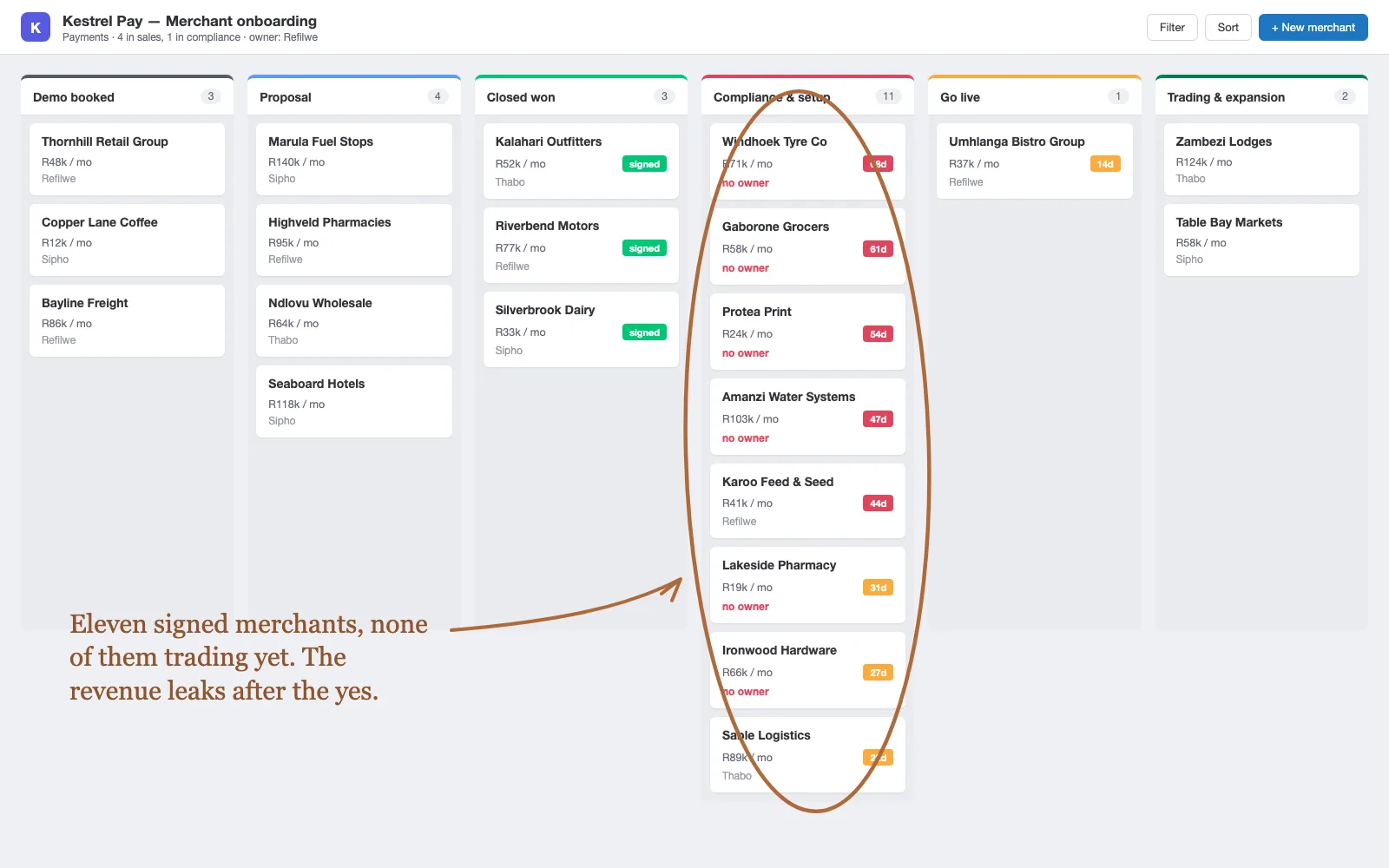
Sales closed a merchant, and the deal went into a queue. Compliance checked it. Onboarding set it up. Retention took it over. Each handover meant re-explaining the client from scratch, usually by email, usually from memory. A merchant who said yes in March could still be waiting to process a payment in June, and nobody in the building could say where the application was without half a morning of asking.
The forecast said one thing. The month-end said another. The gap between them was the queue.
Four teams is fine. Four teams and no owner is not.
Not effort, and not the people. A deal closing wasn’t the finish line. Sales handed off to compliance, compliance to onboarding, onboarding to retention, and every handover meant re-explaining the client from scratch. Nobody owned an application end to end, so a stall just sat there until someone happened to ask.
Fifteen or more deals stuck mid-process at any time, each one already paid for: the commission spent, the discount given, the full cost of winning the work spent before it started leaking.
A handover by email is a handover into nobody’s hands.
The question that took half a morning to answer.
Where is this merchant’s application, and how long has it been there? Simple enough to ask, and it took half a morning of phoning between teams, because the answer lived in four inboxes and nobody owned the whole of it.
Before anything is designed I want two numbers, and most businesses can’t produce either on the day I ask. How many merchants have signed but are not yet processing? And for each one, how many days since the signature? The first number is usually said out loud with some discomfort. The second is usually unknown, because the board ends at closed won and nothing after it has an age.
That is the whole diagnosis in two questions. A business that can answer both already has an owned queue. This one couldn’t, and it was losing revenue it had already paid to win.
A merchant who says yes in March and processes in June was never a sales problem.
One record. One owner. One number.
- 01
The KYC pack moved to the front of the deal
The single change that moved the most days was not a system change at all. It was asking for the compliance pack at the demo instead of after the signature. Gathered while the merchant is keen, it takes a week. Chased once the deal is signed and the salesperson has moved on, it takes a month, because nobody on either side is in a hurry any more. So the pack became an entry checklist on the stage before it was needed, and the stage did not advance without it. Same rule as the rest of the pipeline: evidence, not optimism.
- 02
One owner per merchant, past the signature
One record per merchant from first contact to first transaction, with a named owner at every stage including the ones after the yes, and a checklist the next team could read before the account arrived. Nothing was ripped out to do it. The CRM kept doing sales, the teams kept their tools, and the four of them got a shared spine rather than a replacement.
- 03
The queue got an age
A view of every application by stage and age fixed more than it should have on its own. A stall became visible inside the week it happened rather than the quarter, and once it was visible it stopped being a mystery and started being a task with a name on it. Fifteen-plus stuck deals became two or three, and stayed there.
- 04
One number replaced the argument
Closed won to first transaction, as a median, reviewed weekly beside a count of everything in the queue and how old it is. That is the whole report. It fits on one screen, and it is the number month-end is actually made of, which is why it settled the standing argument between a forecast that said one thing and a bank statement that said another.
- 05
Three markets, one system
South Africa, Namibia and Botswana were running the same pipeline with different local habits, and a process document would have produced three interpretations of it. Each market’s team was trained on the system directly, on their own live applications, with local compliance requirements as stage checklists rather than separate boards. Different requirements, same shape, which made the numbers comparable across markets for the first time.
The numbers are the client’s own.
| Measure | Before | After |
|---|---|---|
| Application processing | 2–4 months | 1–4 weeks |
| Deals stuck mid-process | 15+ | 2–3 |
| Time for a stall to surface | a quarter | inside the week |
| Markets on one system | — | 3 |
| Handover | email from memory | a checklist the next team reads before the account arrives |
The part I’m proudest of
The half-morning question became a ten-second one. Where is this merchant, and how long has it been there, answered by anyone in any of the three markets by looking at one screen. That’s what “one owner” looks like from the inside: not more meetings, fewer.
Count the expansion from day one.
The build was about getting merchants live. It did that. What it didn’t do from week one was put a stage after “live” with a trigger and an owner, so the second product happened when the merchant thought of it. On every payments build since, expansion goes on the board on day one, even as an empty column, because the cheapest revenue in the business is sitting inside merchants who are already processing.
The other thing: I’d have asked for the “signed, not processing” count before the first call, not on it. Half a morning is a diagnosis in itself.
The industry’s own research points the same way.
None of what follows is my data. It’s why I looked where I looked, and why I’d expect the same shape in your business.
Banking found the same leak
McKinsey’s research on corporate client onboarding in banking, the industry next door to payments, found onboarding processes that are slow, duplicative and overly complex, causing potential customers to drop off before they ever transact. And it found that what corporate clients care about most is almost embarrassingly simple: minimal handoffs, and never having to give the same information twice. That is Leak 04, diagnosed independently, at institutions with a thousand times this client’s headcount.
The cost has been rising for three years
Fenergo’s surveys have tracked what slow onboarding costs for three years running: 48% of financial firms losing clients to it in 2023, 67% in 2024, 70% in 2025. The most-cited cause in 2024 was poor data management and siloed processes, named by 86% of the banks asked. Siloed is a polite word for four teams and no owner. Banks say they contact a client four times during onboarding; the clients say eight.
The first ninety days start at the signature
Jason Lemkin’s line is that the first ninety days are where most churn happens. In a payments business most of those ninety days are spent in a compliance queue nobody owns, so the clock is running before anyone in retention has heard the merchant’s name. And on the other side of go-live: ChartMogul’s data has companies with net revenue retention over 100% getting more than half their revenue from expansion, and growing more than twice as fast. Expansion is a stage with a trigger, or it’s a hope with a quota attached.
Voices revenue leaders already listen to
Time to First Value (TTFV) is the amount of time between the close of the sale and when the customer is Onboard.Lincoln Murphy · Sixteen VenturesThe clock starts at the signature. If your board ends there, you’re not measuring the clock.On the board: closed won → first transaction, in days, reviewed weekly.
The first 90 days are where most churn happens.Jason Lemkin · SaaStrMost of those days, in a payments business, are spent in a compliance queue nobody owns.On the board: the stages after the yes, each with an owner and an age.
Burying customer success under sales does not work.Nick Mehta · GainsightNeither does burying the merchant in an email between the two.On the board: one record, one owner, past the yes.
It’s also easier to get more money from an existing customer than it is to get from a new one.Patrick Campbell · ProfitWellEasier, and currently nobody’s job.On the board: an expansion stage with a trigger and an owner, or it’s a hope.
McKinsey & Company, “Winning corporate clients with great onboarding” (2022) · Fenergo, Financial Crime Industry Trends 2025 and October 2024 press release · Thomson Reuters Global KYC Surveys (2017), via Corporate Compliance Insights · Jason Lemkin, SaaStr (2020, 2025) · ChartMogul, SaaS Retention: The New Normal (2024) · Lincoln Murphy, “Customer onboarding: time to first value” (2019) · Nick Mehta, SaaStr Podcast 212 (2019) · Patrick Campbell, SaaStr Podcast 429 (2021)
Your last ninety days of merchants, demo to first transaction.
This build started with two numbers nobody could produce: signed but not processing, and days since signature. What came out of it was a named owner at every stage after the yes, and a view of the queue by age. Both are fixes on the menu now, each at a flat price: Fix our handoff and Automate the alerts. The call confirms the cause; it can’t raise a listed price.
Fix our handoff · Automate the alerts
$1,350 + $1,700 · cheaper built together
Put these fixes on my sheetYour last ninety days of merchants, by stage and age from demo to first transaction, in seven days.
$1,550 · goes toward the fixes you start inside 30 days
Find the leak →Not sure yet? Start with the pack.
The KYC-at-demo document list and the first-transaction queue are free on the payments page for your first name and email. Fill in the sheet, send me the two numbers, and I’ll tell you what they say.
If your problem is pricing or product-market fit, a pipeline is not the fix, and I’ll say so before you pay me anything. If you’re fully self-serve with no sales-assisted onboarding, the queue I fix doesn’t exist in your business.
// The numbers are the client’s own.
Nothing broken. Nothing built.
If that line describes your business, the first call is free, and I’ll tell you where I think it’s leaking whether or not you ever work with me.