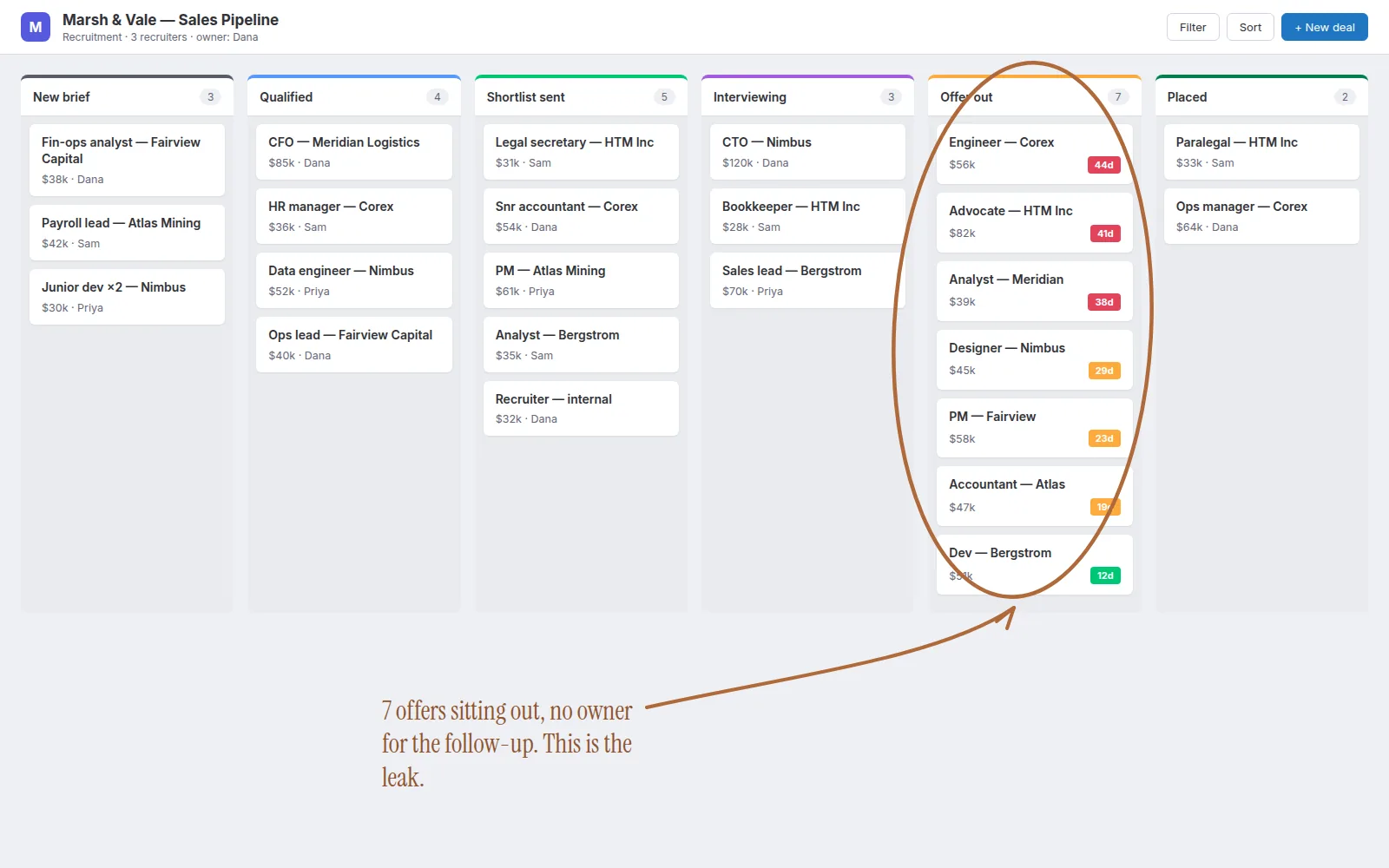
The recruitment pipeline dies at offer out.
Brief → shortlist → interview → offer out → placement → repeat. Agencies are built on relationships and memory, which works until the second consultant starts. Then offers sit with nobody’s name against them, the placement dies in the silence between candidate and client, and the placed client is never asked for the next brief.
Case 02 · Legal staffing, California · Pitch to placement 16% → 30%+ · Built the system, then ran the team on it
Last updated
Tick the ones you’ve said this month.
// Nothing is sent anywhere. It just counts.
0 of 6 ticked Two or more is the point where we should talk.
It’s rarely a people problem. Almost always, it’s a process problem.
One person’s memory. Unowned offers. Forgotten clients.
Three stages, in your vocabulary. I use your terms on the first call; you shouldn’t have to translate your own business for me.
- Whoever’s running it
The process is a person.
You call it: “Brief taken” · “I’ll train them myself”
The founder closes at a rate the market would envy, and every brief lives in their head. Fine at one consultant. A hard ceiling at two, and three months of ramp for every hire. Most agencies train the second consultant the same way: the best recruiter shows them informally, until the best recruiter is busy, promoted or gone. “Brief taken” usually means talked about. A brief belongs on the board when the role, the rate and the interview slots exist in writing; and contingent and retained are two pipelines with two cadences, not one board and a fiction for a forecast.
The fixStages with entry evidence the client has to supply, and the founder’s method written down as a playbook a new consultant runs in week one.
- Offer out
Nobody owns the next touch.
You call it: “Waiting on the candidate” · fall-through · counter-offer
The most expensive stage in the agency. The candidate is weighing it, the client is waiting, the consultant is on the next brief, and nothing in the system notices until one side phones. Across 230,000 offers tracked by one hiring platform, candidates who accepted had been in the offer stage about two days; candidates who declined, closer to six. Every day an offer ages without an owner is a day the counter-offer gets cheaper; half of candidates who accepted an offer in a recent Gartner survey stayed open to other opportunities afterwards. Accepted is not placed. And a fall-through is rarely bad luck: it’s a stage that advanced without evidence, a candidate who never confirmed, a client who never committed a slot.
The fixAn owner and a dated next touch on every live offer, with a scripted cadence at day 0, 1, 2 and 5.
- Repeat
The pipeline ends at “placed”.
You call it: “We’re great once we’re in” · rebate period · repeat brief
A placed client has a second brief within the year, for somebody. Two in five clients don’t return to the same agency for a second job, and the main cause, in Bullhorn’s data as Greg Savage reported it, is that nobody kept the relationship up after the order closed. The rebate period is ninety days you’re still exposed to, so a placement shouldn’t close on the board until it clears; and the repeat brief is the cheapest revenue in the agency, on the one stage most boards don’t have at all. Acquiring a new client costs five to twenty-five times what keeping one does. That estimate is HBR’s, and it’s conservative for recruitment.
The fixA stage after “placed”: day 30 check-in, day 90 rebate clear, next brief asked for.
Nobody in the agency is slacking. The numbers say the design is.
Four figures from sources a recruiter already reads. None of them are mine, which is rather the point.
The top reason: a better offer elsewhere. Yours was sitting in a queue when it arrived.
Source · Bullhorn GRID Industry Trends, 2026
Either the process took too long or they found another job before the firm finished. A further 30% left over too little communication.
Source · Bullhorn, 2023
“The recruiter does not put enough effort into maintaining the relationship after the order is closed.”
Source · Bullhorn data, reported by Greg Savage, 2024
Down from 85% two years earlier. Half of what goes out now comes back as a no.
Source · Gartner, 2026
// Figures are US, UK and global. The stage names differ. The leak doesn’t.
Two pipelines, one owner per record.
The client pipeline drawn with the evidence a client has to give before a brief advances (a partner has committed an interview slot, not “the call went well”). A candidate pipeline that meets it in the middle. An owner and a next-step date on every record. A follow-up cadence on every offer out, because that’s where placements were quietly dying. A weekly review on one screen: offers older than seven days, brief-to-placement time, repeat briefs per client.
Then the founder’s method written down as a playbook a new consultant runs in week one, and the team trained with me in the room.
Nothing gets ripped out that already works. If the ATS is doing the candidate side well, I build the client side beside it.
Three numbers you’d watch afterwards. Not a dashboard nobody opens.
Counted by owner, not in total. An unowned offer is the one that ages.
Median, not average. One 90-day retained search hides ten quick ones.
The number that says whether you have a book or a run of one-offs.
Proof. Built it inside an agency, then ran the team on it.
Everything works, because one person is personally doing it.Pitch to placement 16% →30%+ Read the case →
- New consultant’s first placement
- 3 months → 1 month
- Offers out, unowned
- 7 → 0
Four touches in five days, and a name against every offer.
The scripted post-offer cadence (day 0, 1, 2 and 5, with the four messages and the day-2 script written out) plus the audit sheet that shows you on a Monday how many live offers have no owner or no next touch. Your first name and email, and both files are yours.
Unlocked · both files are below
3 pages · A4
Google Sheet · one click makes your own copy
If you want the read: fill in the sheet, send me the number in the top-right corner, and I’ll tell you what it says. No call needed.
Built on relationships. Which is the problem.
Asked most often by owners with one consultant and a second one coming.
-
Tracking
What should a recruitment CRM actually track?
Two pipelines that meet in the middle: the client pipeline (brief, shortlist, interview, offer out, placement, repeat) and the candidate pipeline, with an owner and a next-step date on every record in both. Then three numbers: offers older than seven days, time from brief to placement, and repeat briefs per client per year.
→ Free CRM setup checklist: three numbers, not a dashboard nobody opens.
-
Your stack
We use an ATS. Do we need a CRM as well?
Usually the ATS is the candidate pipeline and is fine at that. The client side — briefs, offers, repeat business — is what tends to live in email and memory. That’s the half I build, in whatever tool fits beside the ATS.
→ CRM problem, or process problem? Nothing gets ripped out that already works.
-
Counter-offers
Isn’t the counter-offer just the market?
Partly. Gartner puts offer acceptance at 48% in late 2025, down from 85% two years before, so yes, the market got harder. But an offer that sits for six days loses to a counter-offer that an offer touched on day two would have survived. You can’t control the market. You can control the six days.
→ Why deals go quiet after a proposal: the counter-offer isn’t waiting.
-
Timing
Does this work for a one-consultant agency?
It works best the quarter before you hire the second one. Build the system while it’s still one person’s method, and the hire inherits a process instead of a head — which is the difference between a first placement in month one and month three.
→ Hiring soon? Build our playbook: fine at one consultant. A hard ceiling at two.
I’ll tell you where I think your pipeline stalls on the first call, whether or not you ever work with me. No charge, no deck.
If you have no client flow yet, no briefs coming in at all, the problem is demand, not process, and I’m the wrong first call. And if you run pure high-volume temp with a fully automated ATS and no client-side selling, there may not be a pipeline problem worth paying me to solve.
Two ways in.
The first call confirms the cause. It can’t raise a listed price: if the cause is different, I swap the fix at its own price.
Every figure on this page, and where it comes from.
Checked 28 August 2026.
- Bullhorn, GRID 2026 Industry Trends Report: “two to three out of five candidates who receive offers are still turning them down”, top reason a better offer elsewhere. bullhorn.com
- Bullhorn, press release, November 2023: 62% of candidates stopped working with a staffing firm for speed-related reasons; 30% over too little communication. businesswire.com
- Greg Savage, “2 out of 5 clients will dump you”, September 2024, citing Bullhorn data: two in five clients don’t return for a second job; relationship not maintained after the order closes. thesra.co
- Gartner, press release, June 2026: offer acceptance 48% in Q4 2025, 54% in Q4 2024, 85% in Q4 2023. gartner.com
- Gartner, press release, August 2023: 47% of candidates who accepted an offer remained open to other opportunities. gartner.com
- Ashby, Talent Trends Report: Offer Acceptance Rates: time in offer ~2 days for accepted, ~6 days for declined, across 230,000 applications. ashbyhq.com
- Harvard Business Review, “The value of keeping the right customers”, October 2014: acquiring a new customer is five to twenty-five times more expensive than retaining one. hbr.org
Placing well. Now make it repeatable.
No charge. Tell me how a brief moves through your agency and I’ll tell you where I think it stalls.