The enquiry was good. The engagement letter is still unsigned.
Enquiry → consult → engagement letter → matter open → billed → repeat instruction. Firms measure billable hours precisely and the pipeline that feeds them not at all. Nearly half of firms can’t be reached by phone; the letter goes out and chasing it is nobody’s billable hour; the matter closes and so does the relationship. It is the same shape as an unowned offer in a staffing agency, and it costs the same way.
No law firm on the client list yet, and I’d rather say so · Nearest evidence: Case 02, an unowned offer · Pitch to placement 16% → 30%+
Last updated
Tick the ones you’ve said this month.
// Nothing is sent anywhere. It just counts.
0 of 6 ticked Two or more is the point where we should talk.
It’s rarely a people problem. Almost always, it’s a process problem.
Intake by inbox. Unsigned letters. Clients who never come back.
Three stages, in your vocabulary. I use your terms on the first call; you shouldn’t have to translate your own business for me.
- Enquiry
Intake lives in an inbox.
You call it: New enquiry · conflict check · “whoever picks up”
Enquiries arrive by phone, form and referral, and land in whichever fee-earner’s inbox caught them. Conflict checks happen in somebody’s head, and as an informal step they quietly delay every engagement letter behind them. Nobody can say how many enquiries last month became matters. Clio’s shoppers found 48% of firms effectively unreachable by phone, and only a third answering email. The firms surveyed, meanwhile, rate their own client experience as good or excellent.
The fixOne intake stage every enquiry lands in, whatever the channel, with the conflict check as its entry checklist and one name against it.
- Letter out
Chasing your own fee agreement.
You call it: Engagement letter · client-care letter · trust deposit · WIP
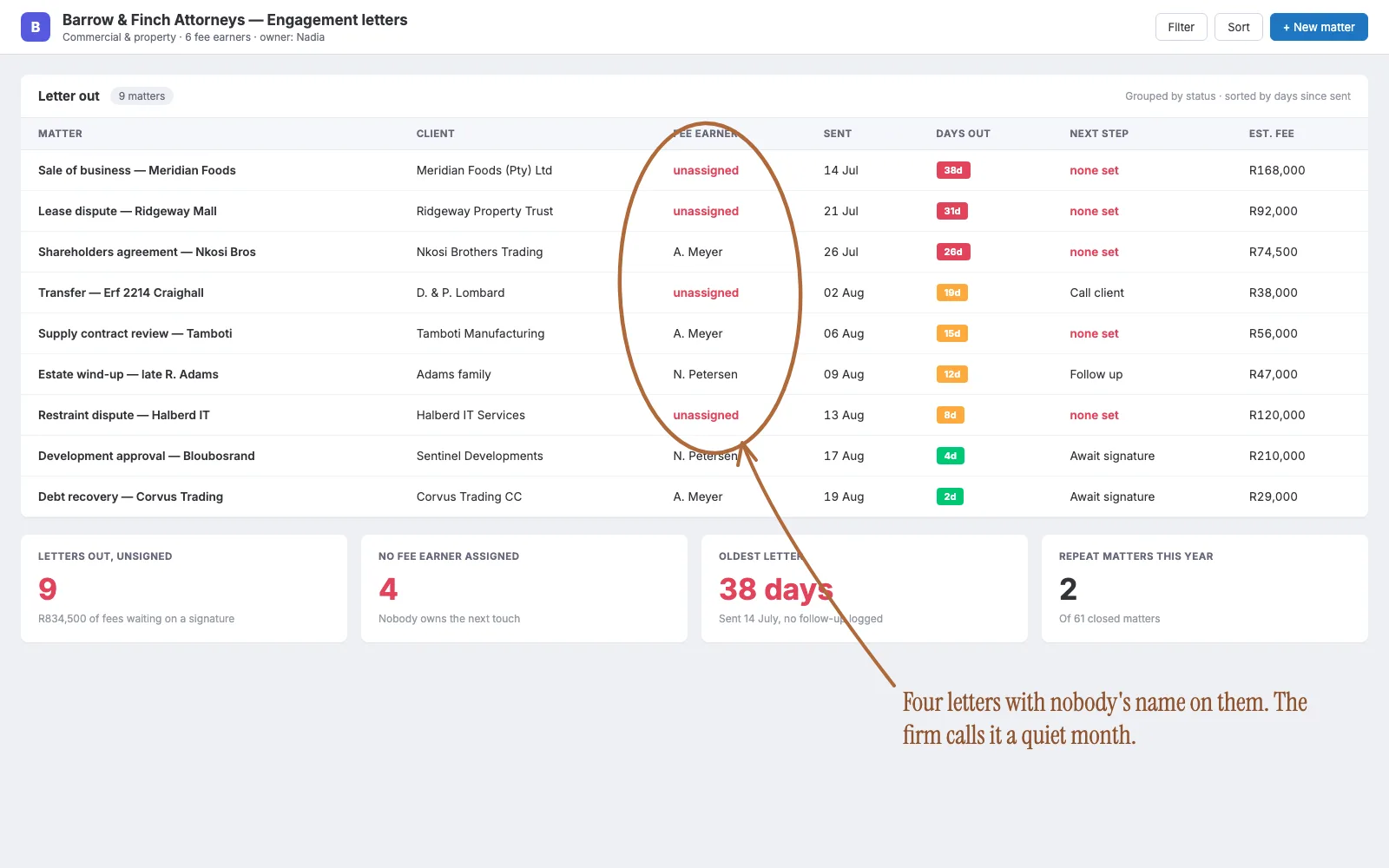
This is your offer stage. The letter goes out, the client goes quiet, and following up is not a billable hour, so it doesn’t happen. The work was won in the consult and lost in the week after it. Fifty-seven percent of people who shop for a lawyer contact more than one firm; 42% stop looking once they like the first one who actually talks to them. The SRA requires the client informed in writing at the time of engagement; the LPC expects fee implications explained up front; ABA Model Rule 1.5(b) wants the basis of the fee communicated, preferably in writing. Every regulator has made this a document. None of them has made it a stage. The trust deposit is the cleanest advance rule a firm can have: no deposit, no matter open.
The fixAn engagement-letter stage with an owner, an age and a cadence (two touches and a close-out), and the deposit as the evidence that opens the matter.
- Repeat
The matter closes and so does the relationship.
You call it: Repeat instruction · “most of our work is referrals” · matter vs client
A satisfied client has a second matter within two years, for somebody. The firm with a review date gets it; the firm waiting for the phone to ring doesn’t. In the UK, “having used the firm before” is the single most common reason a consumer picks a firm. Firms that track only matters never see the client’s next instruction coming, and clients, in Thomson Reuters’ words, “do not tend to ask their law firms to change. Instead, they vote with their feet and their dollars.”
The fixA review date on every closed matter, with the next-instruction ask written into it.
Nobody in the firm is slacking. The numbers say the design is.
Four figures from sources a partner already reads. None of them are mine, which is rather the point.
Down from 56% in 2019. A third answered the email, down from 40%. It got worse, not better.
Source · Clio Legal Trends Report, 2024
A 38% utilisation rate. The other five hours are measured nowhere, and the pipeline lives in them.
Source · Clio, 2025
24% poor communication, 22% delay or failure to progress. A quarter of complainants never got a final response from their provider.
Source · Legal Ombudsman (England & Wales), 2025/26
And 91% can’t measure the return on their advertising. Billable hours to the minute; the pipeline not at all.
Source · Clio Legal Trends Report, 2017
// Figures are US and UK. The stage names differ. The leak doesn’t.
One intake. One owner per matter.
A single intake stage every enquiry lands in, whatever channel it arrived on, with the conflict check as its entry checklist and one name against it. An engagement-letter stage with an owner, an age and a follow-up cadence, because that is where the work is actually being lost. Trust deposit as the evidence that opens a matter, so nothing advances on optimism. Then a review date on every closed matter, with the next-instruction ask written into it.
Built in whatever the firm already runs beside the practice management system, with the practice manager trained directly rather than handed a manual. The matter side usually works; it is intake and the letter that live in email.
Three numbers you’d watch afterwards. Not a dashboard nobody opens.
By fee-earner. Day 5 is the call; day 8 is when you name the date the file closes.
By channel. Most firms cannot answer this, which is why intake never improves.
Over two years. The number that says whether you have a client base or a run of matters.
Evidence. No legal case study yet, and I’d rather say so.
There is no law firm on my client list. What I have is the sales operation I built inside a US legal staffing firm, where the leak was an offer sitting out with nobody’s name against it. An unsigned engagement letter is the same object: the work is won, the document is with the other side, and following it up is nobody’s billable hour. The shape of the loss is identical, and so is the fix: an owner, an age, and a cadence. That makes it a well-founded expectation, not a legal case study, and the honest thing is to say which one you’re buying. I’ll show you the work on the first call and you can decide whether it transfers.
Everything works, because one person is personally doing it.Pitch to placement 16% →30%+ Read the case →
- Offers out with no owner
- 7 → 0
Whether navigating a complex contract, brainstorming strategy for a deal, or refining a sales approach, she always took the time to provide actionable, empowering guidance.
Her default mode is always: how can we make this better, smarter, and more efficient?
Two touches, one close-out, written so a partner will send them.
The engagement-letter cadence at day 0, 2, 5 and 8, with both emails written out in the register a partner already uses with a client who hasn’t returned a signed board resolution, plus the worksheet that counts letters sent, signed and unsigned by fee-earner over ninety days. Your first name and email, and both files are yours.
Unlocked · both files are below
2 pages · A4
Google Sheet · one click makes your own copy
If you want the read: fill in the sheet, send me the ninety-day count (sent, signed, unsigned), and I’ll tell you what it says. No call needed.
Billable hours, measured to the minute. The pipeline, not at all.
Asked by managing partners and by the practice manager who actually runs intake.
-
Fit
Is a CRM even appropriate for a law firm?
Your practice management system runs matters, and it should keep doing that. What is missing is everything before a matter exists: enquiries, conflict checks, consults and unsigned letters. That is a pipeline, and it is currently an inbox. I build the front half beside what you already have.
→ CRM problem, or process problem? The matter side usually works.
-
Ethics
We can’t chase clients like a sales team.
Agreed, and I wouldn’t. A follow-up on an engagement letter the client asked for is a service, not a pitch. The cadence is two touches and a close-out, and the close-out, told plainly, is often what gets the letter signed. The Ombudsman’s top two complaints are poor communication and delay. This is the cure for both.
→ What Chase the proposal builds: a follow-up on a letter they asked for is service.
-
Compliance
Doesn’t our client-care letter already cover this?
It covers the content. The SRA, the LPC and the ABA all tell you what the letter has to say. None of them says what happens on day nine if it hasn’t come back. A stage with an owner and an age is what turns a compliant document into a signed one.
-
First look
What would you look at first in our firm?
Ninety days of enquiries and ninety days of engagement letters. From the first: how many arrived, through which channel, and how many became matters. From the second: how many went out, how many came back signed, and how long the unsigned ones have been sitting. Most firms can produce billable hours to the minute and neither of those two counts at all. That gap is the whole argument: the part of the firm that is measured improves, and the part that isn’t, doesn’t.
→ How do you audit a sales pipeline? Ninety days of letters. One honest number.
I’ll tell you where I think your intake leaks on the first call, whether or not you ever work with me. No charge, no deck.
If enquiries aren’t coming in yet, the problem is demand, not process, and I’m the wrong first call. And if your work is all panel-appointed or institutional, there may not be a pipeline problem worth paying me to solve.
Two ways in.
The first call confirms the cause. It can’t raise a listed price: if the cause is different, I swap the fix at its own price.
Every figure on this page, and where it comes from.
Checked 28 August 2026.
- Clio, 2024 Legal Trends Report highlights: 33% of firms responded to email (40% in 2019), 40% answered the phone (56% in 2019), 48% unreachable by phone. clio.com
- Clio, 2019 Legal Trends Report: 56% answered calls in 2019; 57% contacted more than one firm. clio.com
- Attorney at Work, Jared Correia on the 2019 Legal Trends Report: 42% won’t call another lawyer if they like the first one they talk to. attorneyatwork.com
- Clio, Legal Trends benchmarks 2025: utilisation 38%, 3.0 billable hours in an eight-hour day. clio.com
- Above the Law on the 2017 Legal Trends Report: 91% can’t measure advertising ROI, 94% lack client-acquisition cost data. abovethelaw.com
- Legal Ombudsman, 2025/26 annual complaints data: poor communication 24%, delay 22%, together 46%; 25% received no final response. legalombudsman.org.uk
- Legal Futures on the Legal Services Consumer Panel Tracker 2023: “having used the firm before” the top reason for choosing a firm. legalfutures.co.uk
- Thomson Reuters, 2019 State of US Small Law Firms: “Clients do not tend to ask their law firms to change…”. dcbar.org
- LexisNexis Bellwether 2026: 84% of small firms rate their client experience good or excellent. lexisnexis.com
- SRA Code of Conduct for Solicitors, 8.3 and 8.7. sra.org.uk
- ABA Model Rule 1.5(b), as reproduced by the ABA Family Law Section, 2026. americanbar.org
Won in the consult. Lost in the week after it.
No charge. Tell me how an enquiry becomes a matter in your firm and I’ll tell you where I think it stalls.