The merchant said yes. The revenue didn’t.
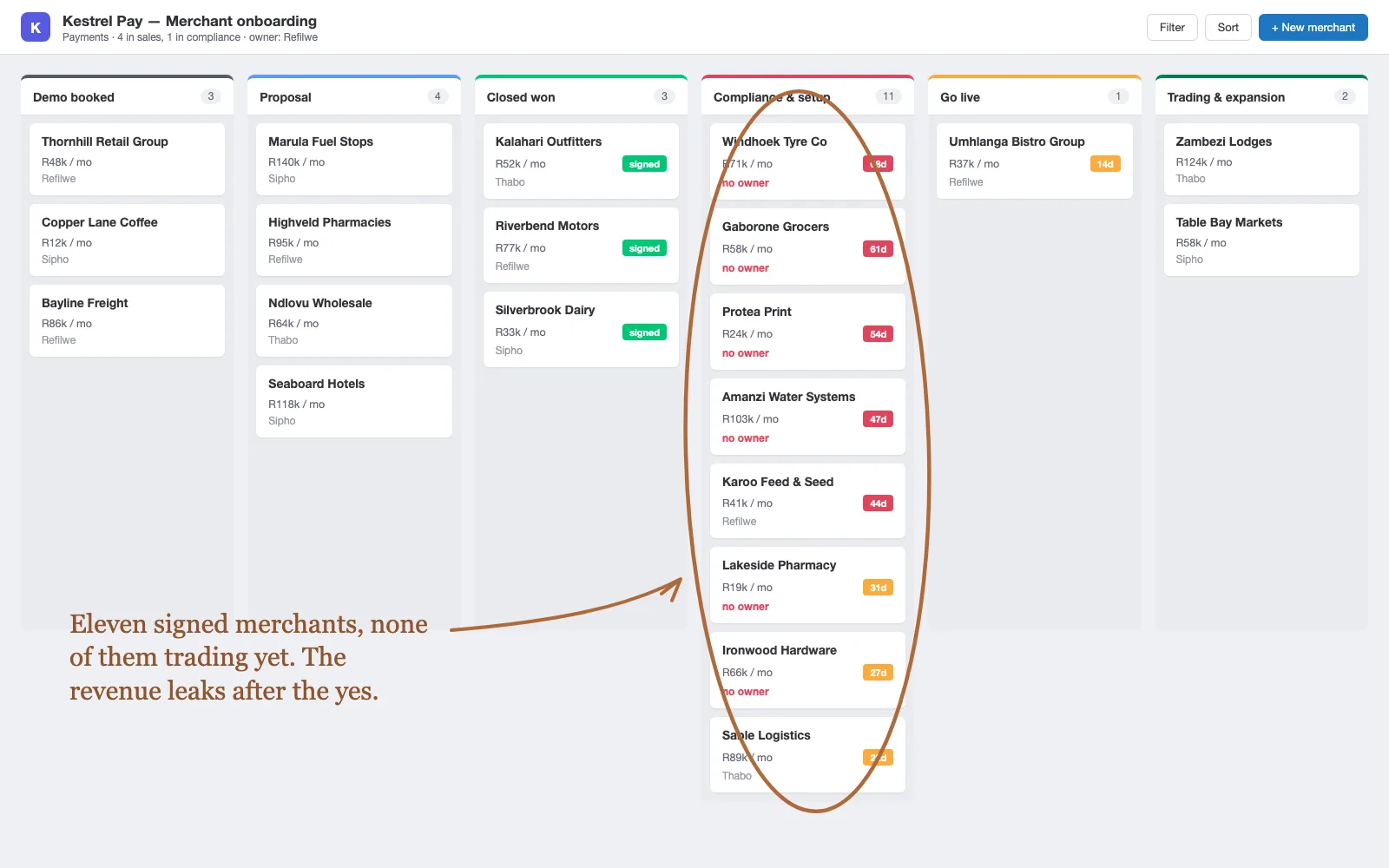
Demo → proposal → closed won → compliance → go live → expansion. Closed-won is the middle of your pipeline, not the end of it, and the half after the signature is the half nobody owns. The KYC pack gets chased instead of collected, four teams hand the merchant to each other by email, and the forecast counts in March what the bank statement sees in June.
Case 03 · Payments provider, three markets · Application processing 2–4 months → 1–4 weeks · Deals stuck mid-process 15+ → 2–3
Last updated
Tick the ones you’ve said this month.
// Nothing is sent anywhere. It just counts.
0 of 6 ticked Two or more is the point where we should talk.
It’s rarely a people problem. Almost always, it’s a process problem.
A queue after the yes. Four teams. No owner.
Three stages, in your vocabulary. I use your terms on the first call; you shouldn’t have to translate your own business for me.
- Closed won
The finish line that isn’t.
You call it: Closed won ≠ live · MRR vs processed volume · time to first transaction
The board ends where the revenue starts. A merchant who signed in March can still be waiting to process in June, and the forecast counted it in March. Sixty-eight percent of companies miss their forecast by more than ten percent; in a payments business the miss is usually sitting in this queue. MRR and processed volume are two different pipelines, and only one of them appears on the sales board. It isn’t the one finance reports. Time to first transaction predicts churn better than any satisfaction score you can collect: most churn happens in the first ninety days, and the first ninety days start at the signature, not at go-live.
The fixThe stages after the yes on the same board, with an owner and an age on every record.
- Compliance
KYC collected too late.
You call it: KYC · KYB · FICA pack · “requirements outstanding” · handover
The pack is chased after the signature instead of gathered at the demo. Gathered at the demo it is a week; chased after the yes it is a quarter. Every document that arrives late is a week of processing volume that never happened. Banks say they contact a client four times during onboarding; the clients say eight. Somebody is counting wrong, and it isn’t the customer. Then the handover: sales to compliance to onboarding to retention, four teams, and in most builds no single owner across the four. In South Africa the FIC Act requires identity established and verified in the course of establishing the relationship, a legal gate before go-live, which is the strongest argument there is for asking at the demo.
The fixThe KYC pack as an entry checklist on the demo stage, and one named owner per merchant across all four teams.
- Expansion
Nobody asks for the second product.
You call it: Cross-sell · upsell · “once they’re settled”
The cheapest revenue you have sits inside merchants already live. No trigger, no owner, no stage, so it happens when the merchant thinks of it. Companies with net revenue retention over 100% get more than half their revenue from expansion, and grow twice as fast as those under it. Salesforce gets roughly three-quarters of its new bookings from existing customers. Your version of that number is currently unknown, because nobody is counting it. That’s not a relationship. That’s a stage.
The fixAn expansion stage with a trigger (first transaction plus ninety days, or a volume threshold) and an owner.
Nobody in the business is slacking. The numbers say the design is.
Four figures from sources a revenue leader already reads. None of them are mine, which is rather the point.
Up from 48% two years earlier. The signed client who walks away during compliance is now the norm.
Source · Fenergo, 2025
Against minutes for a payment facilitator. Every day in between is one the merchant spends comparing you to the alternative.
Source · Mastercard, 2024
And 55% say it feels like separate departments rather than one company. That is what a handover by email feels like from the other side.
Source · Salesforce, State of the Connected Customer
Only 9% get within 5%. In a payments business the miss has a name: signed, not processing.
Source · InsightSquared, 2021
// Figures are global; Fenergo’s samples are banks and asset managers, not acquirers. The stage names differ. The leak doesn’t.
One record per merchant, first contact to first transaction.
A named owner at every stage, including the stages after the yes. The KYC pack moved forward into the demo as an entry checklist rather than chased afterwards. Handover replaced by a checklist the next team can see before the account arrives. A view of every application by stage and age, so a stall becomes visible inside the week it happens rather than the quarter.
Then the same system rolled out across every market you operate in, with the local teams trained on it directly rather than sent a process document. Nothing gets ripped out that works: if the CRM does sales well and a service desk does onboarding well, the two get a shared spine rather than a replacement.
Three numbers you’d watch afterwards. Not a dashboard nobody opens.
By owner. Fourteen days is where an application stops moving without a nudge.
Median days. This is the number your month-end is actually made of.
A count, reviewed weekly. If nobody can say it out loud, it is too high.
Proof. The forecast said one thing. Month-end said another.
I can see revenue in the pipeline. I can’t see it on month-end itself.Application processing 2–4 months →1–4 weeks Read the case →
- Deals stuck mid-process
- 15+ → 2–3
- Markets on one system
- 3
The documents to ask for while they still want you.
The demo document list, by market (UK, US and South Africa), with the line to say on the demo, plus the one-screen queue of everyone who has signed and hasn’t transacted. Your first name and email, and both files are yours.
Unlocked · both files are below
3 pages · A4
Google Sheet · one click makes your own copy
If you want the read: fill in the sheet, send me the two numbers in the top-right corner, and I’ll tell you what they say. No call needed.
Sales isn’t the bottleneck. The queue behind it is.
Asked by founders, sales directors and the ops lead who inherits the queue.
-
First move
What do we fix first?
Move the KYC pack to the demo. It is the single cheapest change and it collapses the compliance stage, because every document that arrives late is a week of processing volume that never happened. Then put one name against each merchant end to end, so a stall has somebody to belong to.
→ Why CRM rollouts die in month three: collected at the demo it is a week.
-
Your stack
We already run HubSpot. Do we replace it?
No. Nothing gets ripped out that works. HubSpot is usually fine at the front half; what’s missing is the half after closed-won — stages, owners and ages for compliance, go-live and expansion. I design the process first and build it where you already work.
→ CRM problem, or process problem? The front half was never the problem.
-
Sales
Won’t asking for KYC at the demo slow the close?
It’s the objection every sales team raises, and the data says the opposite: the merchants who leave are the ones who were asked eight times after signing, not once before. A merchant who’s keen hands over documents. A merchant who’s been waiting six weeks doesn’t.
-
Scale
We operate in three countries. Does one pipeline hold?
It held across South Africa, Namibia and Botswana. One pipeline, local compliance requirements as stage checklists rather than separate boards, and each market’s team trained on it directly. Different requirements, same shape — which is what makes the numbers comparable across markets for the first time.
→ Reset my stages, with the extra agreed in writing before work starts: three markets, one system.
I’ll tell you where I think your merchants stall on the first call, whether or not you ever work with me. No charge, no deck.
If your problem is pricing or product-market fit, a pipeline is not the fix, and I’ll say so before you pay me anything. And if you’re fully self-serve with no sales-assisted onboarding, the queue I fix doesn’t exist in your business.
Two ways in.
The first call confirms the cause. It can’t raise a listed price: if the cause is different, I swap the fix at its own price.
Every figure on this page, and where it comes from.
Checked 28 August 2026.
- Fenergo, Financial Crime Industry Trends 2025, October 2025: 70% of firms lost clients in the past year to inefficient onboarding, up from 67% (2024) and 48% (2023). fenergo.com
- Thomson Reuters 2017 Global KYC Surveys, via Corporate Compliance Insights: banks report four client contacts during onboarding, corporates report eight. corporatecomplianceinsights.com
- Mastercard, Digital Merchant Onboarding, April 2024: 3–7 days for a traditional acquirer to onboard a merchant; minutes for a PayFac. mastercard.com
- Salesforce, State of the Connected Customer (6th ed.), as cited by Salesforce: 56% often re-explain themselves; 55% feel they’re dealing with separate departments. salesforce.com
- InsightSquared, 2021 State of Sales Forecasting: 68% miss forecast by more than 10%; 9% within 5%. insightsquared.com
- ChartMogul, SaaS Retention: The New Normal, 2024: companies with ≥100% NRR get over half their revenue from expansion and grow more than twice as fast. chartmogul.com
- Jason Lemkin, SaaStr, “What’s more important, new customers or retention?”, August 2020: 73% of Salesforce’s new bookings from existing customers. saastr.com
- Jason Lemkin, SaaStr, “Onboarding and time to value should be the #1 goal for customer success”, May 2025: “The first 90 days are where most churn happens.” saastr.com
- Financial Intelligence Centre Act 38 of 2001, s.20A and s.21(1). saflii.org
Closed-won isn’t revenue. The first transaction is.
No charge. Tell me how a merchant moves from demo to first transaction and I’ll tell you where I think it stalls.