Where the adviser or broker pipeline actually leaks.
Most practices sell well. Then the enquiry nobody owned goes quiet, the file nobody chased after the yes sits on a desk for three weeks, and Monday’s pipeline number is whatever got typed into the CRM on Friday.
Case 01 · 30+ practices · underwriting 40–90 days → ~1 month · BrightRock Top New Business, 2021
Last updated
- Lead
- FNA
- Propose plan
- Underwriting
- Annual Review
Where does an adviser/broker practice lose revenue? Not in the room. It loses it at the inbox where paid leads arrive and nobody owns the call; in the days between “the client said yes” and “the application is complete”, because no stage exists where finishing it is anyone’s job; and in a CRM built for a report instead of the person using it. Give each an owner, a date and a view, and most of the leak closes. The rest of this page is the evidence, the price, and the pack to start with.
Tick the ones you’ve said this month.
// Nothing is sent anywhere. It just counts.
0 of 6 ticked Two or more is the point where we should talk.
It’s rarely a people problem. Almost always, it’s a process problem.
An enquiry nobody owns. A file nobody chases. A CRM nobody opens.
Three places, in your vocabulary. I use your terms on the first call; you shouldn’t have to translate your own business for me.
- Before the first meeting
You pay for leads. The leads arrive. Then what?
You call it: “the campaign leads” · “whoever’s free” · “I’ll follow up Friday” · Broker: the quote request
If the honest answer is “whoever’s free calls them when they get a gap”, the money isn’t lost in the lead. It’s lost in the two days after it, when nobody owned the call, the follow-up went into an inbox and the person who enquired got quoted by someone else.
Paid leads are the most expensive enquiries a practice will ever receive, and the ones with the least process around them.
The fixOne enquiry path: form, qualification, routing, booking and the first reply, with an owner at every step.Fix my intake · $2,750 Excludes VAT, if applicable.
- After the yes
The file travels by memory.
You call it: “requirements outstanding” · “waiting on the insurer” · Section 14 · UK: pension transfer · US: 1035 exchange · Broker: bound but not on risk
The client said yes in the meeting. Three weeks later the policy still isn’t on the books, and nobody can say whose desk the file is on. Medicals booked after the application instead of at the first meeting. Requirements chased one at a time. A transfer form that could have been signed on day one, waiting for the next meeting.
A traditional underwriting decision takes around 27 days from an application in good order. Nothing you do shortens the insurer’s 27. Everything you do decides how long “in good order” takes, and no insurer publishes an NTU (not-taken-up) rate, so you have no way to prove which delays were yours and which were theirs. That opacity suits everyone except you.
The fixWhat delivery needs before it starts and who owns the client after the yes, with the trigger, checklist and tracking that hand it over.Fix our handoff · $1,350 Excludes VAT, if applicable.
- Underneath both
Built for a report, not the person using it.
You call it: “the system” · “I’ll update it Friday” · “the CRM doesn’t work for us” · Broker: the renewal date nobody flagged
You pay for the CRM every month. Your advisers/brokers run their day from WhatsApp and a notebook. So Monday’s pipeline number is whatever someone remembered to type in on Friday, the forecast is a polite guess, and the two leaks above are invisible because nothing is recorded where they happen.
It’s not that they’re lazy. It’s that the system was built for a report, not for the person using it.
The fixThe workflow cut down to what the team actually uses, a view for each role, training and an adoption check at day 30.Get the team back in · $1,500 Excludes VAT, if applicable.
The book you already have is the cheapest revenue in the practice. That’s the second conversation, once the handoff is running.
Nobody in the practice is slacking. The system is.
Four figures from bodies an adviser/broker already reads. None of them are mine, which is rather the point.
In 2024 South African life insurers sold 10.39 million new recurring-premium risk policies and saw 8.20 million lapse. A book that isn’t reviewed drains almost as fast as it fills.
Source · ASISA, 2025
The rest goes to report preparation (20%) and compliance and admin (18%). Advisers say the ideal is 51% with clients.
Source · Fidelity Adviser Solutions, 2025
The FCA looked at the UK’s 22 largest advice firms. In 15% of cases the client declined the review or didn’t respond to the offer; in under 2% nobody tried. The regulator’s question wasn’t “did you mean to?” It was “where’s the evidence?”
Source · FCA, 2025
Referrals account for 67% of new clients. Only 44% of firms managing $250m or more have a written plan for generating them; smaller practices rarely have one either.
Source · Schwab RIA Benchmarking, 2024 & 2026
// Figures are US, UK and SA, advisers and brokers both. The stage names differ. The leak doesn’t.
Anticipate instead of react.
Designed first, then built in whatever the practice already runs. Rolled out practice by practice, with each administrator trained in the room rather than handed a manual. I don’t sell software and I don’t sell an AI bot. Where a different tool would genuinely earn its keep I’ll say so, and say why. Most of the time that tool is the one you already pay for.
- Before the first meeting
Every enquiry, paid or not, lands with a person, not an inbox: qualified, routed, booked and answered inside a set time, with the rule that fires if it isn’t.
- After the yes
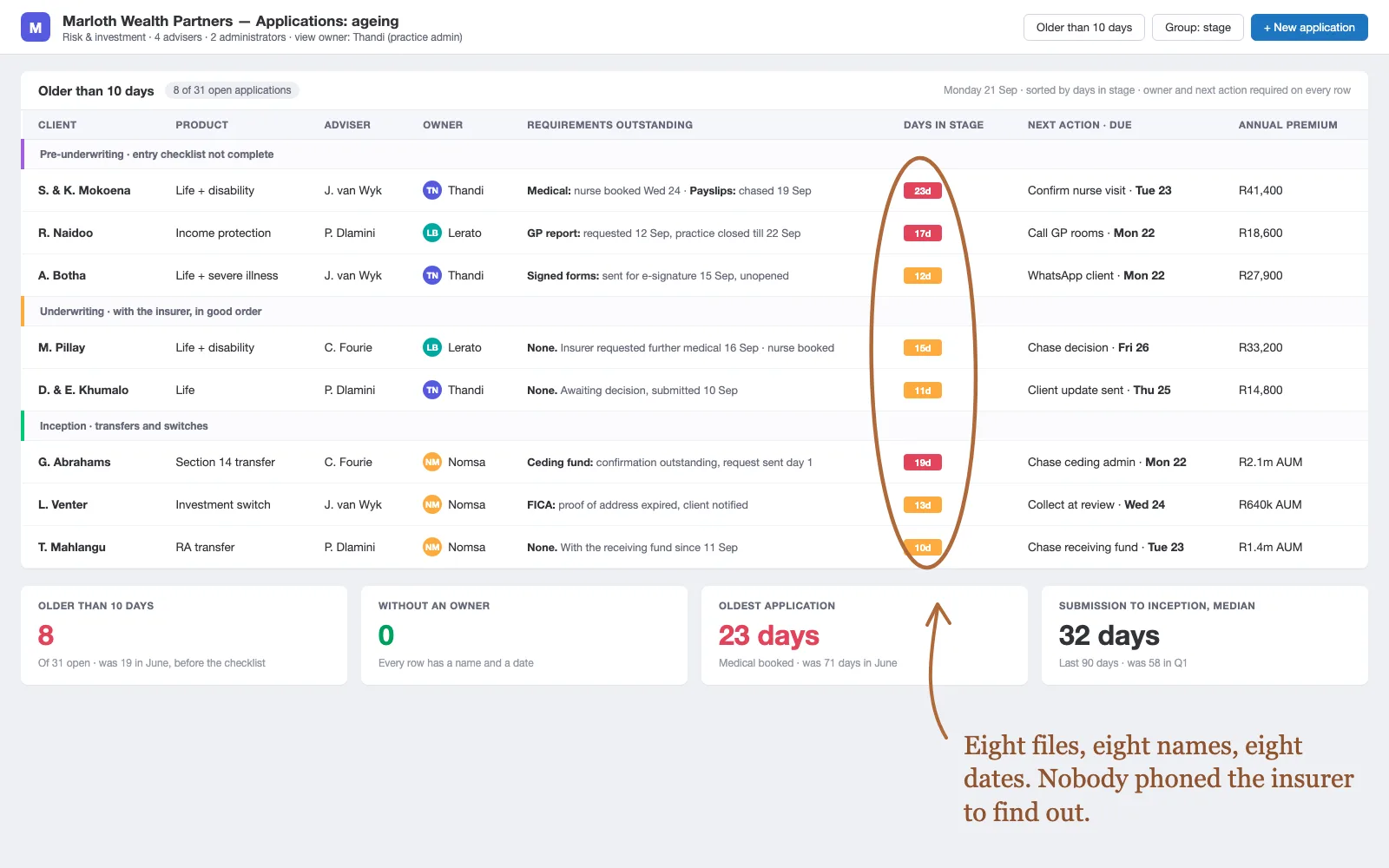
A pre-underwriting stage owned by the administrator, with an entry checklist: medicals booked, documents in, forms signed before the client leaves the room. Transfer requests templated so they go out the day the client signs. A standing view of every application older than ten days, by stage, by owner.
- Underneath both
The CRM cut down to the few fields that matter, a view for each role, the pipeline number read off the screen on a Monday without asking anyone, and a check at day 30 that the team is still in it.
Three numbers you’d watch afterwards. Not a dashboard, three numbers.
By stage, by owner. The number that used to be invisible, on a screen you can read on a Monday.
The metric the client actually experiences, and the one that tells you whether “in good order” got shorter.
How long a paid lead waits before a person, not an autoresponder, is in touch. Measured in hours, not days.
- Investment transfers, one adviser practice
- 2–3 months → 4–6 weeks
- Underwriting turnaround, 30+ practices on one operation
- 40–90 days → ~1 month
Case 01: the whole build, and what it looked like from the administrator’s chair →
Three fixes, priced before we talk.
Every fix is a flat price with a cap. Inside the cap the number holds; over it, the extra is agreed in writing before work starts. No custom quotes, nothing to negotiate.
- “Enquiries come in and nobody owns them.”Fix my intake$2,750Excludes VAT, if applicable.
One enquiry path: form, qualification, routing, booking and the first reply, with an owner at every step.
Cap · one enquiry path, one team
- “Sales closes it, then delivery starts from scratch.”Fix our handoff$1,350Excludes VAT, if applicable.
What delivery needs before it starts and who owns the client after the yes, with the trigger, checklist and tracking that hand it over.
Cap · one handoff between two teams
- “The team stopped using the CRM.”Get the team back in$1,500Excludes VAT, if applicable.
The workflow cut down to what the team actually uses, a view for each role, training and an adoption check at day 30.
Cap · one team, one pipeline
- Two together: the second fix comes off $130 for the shared setup, because kickoff, access and handover happen once. Where two fixes share real work, that comes off as well, on its own line.
- Can’t name it? Find the leak is seven days in your own CRM for $1,550: the stage deals stall in, the number that proves it, the first three things I’d change. It goes toward the fixes you start inside 30 days, up to their price.
- The hold: every price holds for 14 days, no deposit. Then a 30-minute call that confirms the cause and cannot raise a listed price.
The guarantee, under every buildThe guarantee starts at handover. If your team isn’t running it thirty days later, I do another thirty days at no charge to find out why and put it right.
The selling is rarely the problem. The operation behind it is.
- Software
Do I have to buy something?
No. I set up the CRM and the admin tools you already pay for, monday.com or HubSpot in most practices, and if you’re on spreadsheets I say so before anything is built. Nothing on this page needs a new subscription.
- First move
What should we fix first?
Start with Fix our handoff: the pre-underwriting checklist and the ten-day view on stale applications, that’s where the money sits for three weeks. If you pay for leads, Fix my intake usually runs alongside it; the same nobody’s-turn problem is happening at both ends. Get the team back in comes last, once there’s something worth logging into daily. The review trigger on the book comes after all three are running.
- Fit
Does it work for a brokerage, not just advisers?
Yes. A short-term brokerage has the same shape: the renewal book is the unmined asset, the claims handover is the unowned stage, and the CRM is the thing everyone updates on Friday. The stage names change. The leaks don’t.
Metrics a brokerage should track: the renewal book is the cheapest revenue in the practice →
- The call
What happens on the call?
One call on your practice, not a pitch. If you’ve already ticked a fix, the call confirms the cause and ends one of three ways: it’s what you said and we start; the cause is different, so the fix is swapped at its listed price; or you’re over the cap, so the extra goes in writing first. If you haven’t, you leave with the first thing I’d change, whether or not we work together.
- Compliance
Isn’t this just a compliance system with a different name?
No, but it does the compliance work as a by-product. The FAIS Code (South Africa’s version of the same rule) wants information gathered before advice; the FCA now wants evidence that paid-for reviews happened. A pipeline with owners and dates produces that evidence on a Monday, not in audit week.
What should pipeline stages actually measure? Evidence, not optimism →
- Not for
Who this isn’t for
A practice with no lead flow: that’s a demand problem, not a process one, and I’ll say so on the call. A book that is entirely tied or panel-fed, where the pipeline is the product provider’s, rarely has a leak worth paying me to fix. Sometimes there isn’t one. Part of the job is telling you that.
The first-meeting document pack, and the sheet that ages it.
What to book, collect and sign before the client leaves the room, one page per product line, plus a tracker that tells you on a Monday which client’s paperwork is ten days old. Your first name and email, and both files are yours.
Unlocked · both files are below
3 pages · A4
Google Sheet · one click makes your own copy
If you want the read: fill in the sheet, send me the number in the top-right corner, and I’ll tell you what it says. No call needed.
Win the business. Don’t lose it in the operation.
Tell me how an application moves through your practice today and I’ll tell you where I think it stalls. You leave with the first thing I’d change, whether or not we work together.
Every figure on this page, and where it comes from.
Checked 28 August 2026.
- ASISA, “South Africa’s life insurers remain well-capitalised…”, April 2025: 10.39m new recurring-premium risk policies sold and 8.20m lapsed in 2024. asisa.org.za
- Fidelity Adviser Solutions, “AI set to unlock the ideal workday”, November 2025: 33% of the day in client meetings, 20% report prep, 18% compliance and admin, ideal 51%. adviserservices.fidelity.co.uk
- FCA, “Multi-firm review: ongoing financial advice services”, February 2025: reviews delivered in around 83% of cases, 15% declined or didn’t respond, under 2% not attempted. fca.org.uk
- Schwab Advisor Services, 2024 RIA Benchmarking Study: referrals 67% of new clients and assets. advisorservices.schwab.com
- Schwab 2026 RIA Benchmarking Study, reported by WealthManagement.com, July 2026: 1.6× new client assets with a documented referral plan; 44% of firms with $250m+ AUM have one. wealthmanagement.com
- LIMRA, “Life insurers look to make the underwriting process easier”, March 2020: traditional underwriting decision 27 days on average from application in good order. limra.com
- FAIS General Code of Conduct s8(1), via Masthead: information to be gathered prior to advice. masthead.co.za