We win the business. Then the admin drags it out for weeks.
— Managing partners, independent advisory practice, on the first call
- Underwriting turnaround40–90 days→~1 month
- Investment transfers2–3 months→4–6 weeks
- Retentionnot measured→95%
- Practices on one operation1→30+
- RecognisedBrightRock “Top New Business”, 2021
Principal-led, adviser-sold, administrator-run.
Independent advisory practices on an insurer’s adviser panel. Life and risk cover, investments and retirement, some short-term. Each one principal-led, each with an adviser or two who win the client in the room and an administrator who carries everything after the yes. The shape you’d recognise from your own office.
Nothing defined what “complete” meant before an application went to the insurer.
The existing book was reviewed when the client called, and retention wasn’t measured at all.
// Two leaks, by the leak map.
Before.
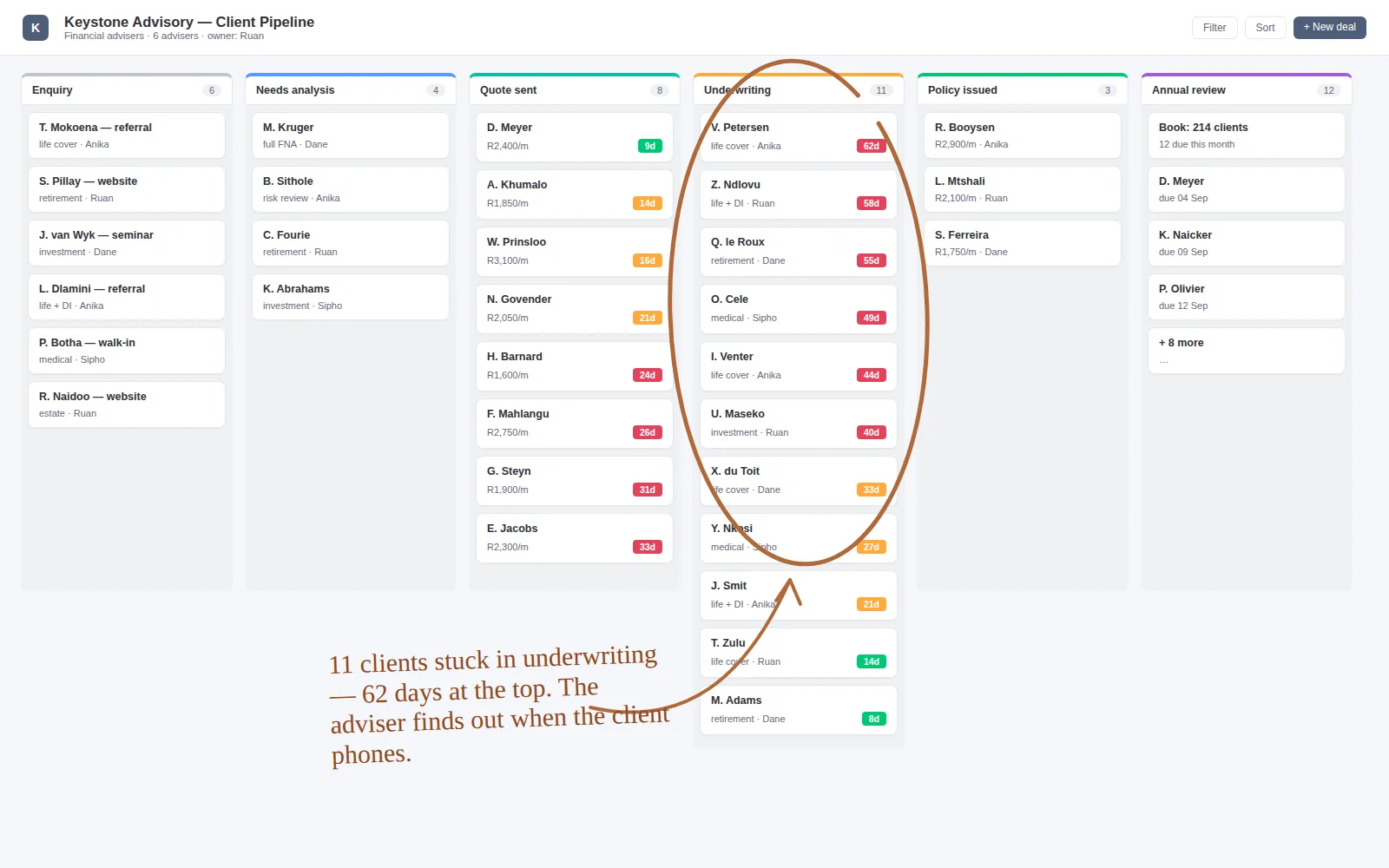
The practices sold well. Advisers won the client in the room, the client said yes, and then the work disappeared into a back office that handled things when they landed rather than before they did. Underwriting requests went out late because nobody had gathered the medicals up front. Investment transfers waited on a form that could have been signed at the first meeting. Every delay surfaced only when the client phoned to ask.
Ask any adviser which stage was slow and they’d say “the insurers”. The data said otherwise: the median delay sat on the practice’s side of the line, in the days between a signed application and a complete one.
Reactive by design. Nobody’s job by default.
Everything got handled when it landed instead of anticipated before it landed. That single design flaw was responsible for the delays, the rework, and a meaningful share of the cancellations being written off as bad luck.
There was no stage between “client said yes” and “application submitted” where someone owned making the application complete. So it was nobody’s job, and it happened in the gaps. Work with no stage is work that happens late or twice.
Not a people problem. Nobody was slacking.
The first week was a spreadsheet of dates.
Not a workshop, and not a system. Every application from the previous quarter, with four dates against it: signed, submitted, underwritten, inception. Subtract, sort, and the argument settles itself.
The median delay sat on the practice’s side of the line, in the days between an application being signed and being complete. That is an uncomfortable number to put in front of a room that has spent a year blaming insurers, so it went up without commentary and the room read it themselves.
It’s worth asking the advisers first anyway. The gap between what a team believes and what the dates say is where the work is.
Ask an adviser which stage is slow and they’ll say the insurers. The dates said the practice.
One stage, one screen, one trigger. Then thirty adoptions.
- 01
The stage that didn’t exist
An explicit pre-underwriting stage, owned by the practice administrator rather than the adviser, with an entry checklist. Medicals booked. Documents in. The forms that can be signed at the first meeting signed at the first meeting, rather than chased three weeks later. Nothing advances without them, which is the same evidence rule the rest of the pipeline runs on.
This is the whole trick, and it is unglamorous. Work that is anticipated before it lands takes a fraction of the time of the same work handled when it lands, because the client is still in the room and still keen. Ask for everything once, while they’re sitting opposite you.
- 02
One standing view, on a Monday
Every application older than ten days, by stage and by owner, on one screen, reviewed at the same time every week. Not a dashboard: a list short enough to read out loud. That single habit converts delays from things discovered when a client phones to ask, into things seen while they can still be fixed.
Re-underwriting and transfer requests were templated at the same time, so they went out the day the client signed instead of the week somebody remembered.
- 03
Then the book they already had
The second leak was the existing book, and it was the cheaper one to fix: a review cadence, a trigger for the second product, and a referral ask that has a stage rather than a good intention. Retention started being tracked the same week, because you can’t hold a number you don’t measure.
- 04
Thirty practices is thirty adoptions
One practice proved the design. The other twenty-nine were the actual work, and none of them were served by being sent the finished process as a document. It went practice by practice, each administrator trained on it directly, in their own book, with their own live applications. That is slower than a webinar, and it is the only version that survives contact with a busy Tuesday.
The numbers are the practices’ own.
| Measure | Before | After |
|---|---|---|
| Underwriting turnaround | 40–90 days | about a month |
| Investment transfer time | 2–3 months | 4–6 weeks |
| Retention | not measured | held at 95% once tracked |
| Practices on the system | 1 | 30+ |
| Recognition | — | BrightRock “Top New Business”, 2021 |
The award went to the work across the adviser panel. BrightRock is the insurer whose panel the work served, not a client of The Pipeline Fixer.
The part I’m proudest of
The “Book of Life”: a structured collection of a client’s essential estate documents, assembled quietly during the relationship and handed to the family when a loved one passed away. It was designed for the client’s experience rather than the operator’s throughput, and it became standard practice across the whole panel. It is the piece the practices still talk about.
Track retention from week one.
It wasn’t measured at all before, and once it was, it held at 95%. But I can’t tell you what it was doing in the months I wasn’t looking, and that is a number I’d rather have had from the start. On every build since, retention goes on the board in week one, before anything is fixed, so the after has a before to stand against.
The part I’d keep unchanged is the Book of Life. Designed for the client rather than for throughput, and the piece nobody has to be reminded to use.
The industry’s own research points the same way.
None of what follows is my data. It’s why I looked where I looked, and why I’d expect the same shape in your practice.
The application is the lever
LIMRA, the life insurance industry’s own research body, clocks a traditional underwriting decision at around 27 days from an application in good order, against 9 days on accelerated paths. Nothing a practice does shortens the insurer’s 27. Everything it does decides how long “in good order” takes, and every document chased after signing is a round trip, and every round trip is a week.
The industry press says the quiet part out loud: the longer underwriting runs, the more policies are never taken up. A six-week wait gives a “yes” six weeks to become a “no”: a health scare, a budget wobble, buyer’s remorse. Cutting cycle time from weeks to days measurably lifts placement rates. McKinsey found insurers that streamlined underwriting saw a 14% median lift in sales volume within two years. The practice’s version is cheaper: ask for everything once, in the room.
The book is the cheapest revenue
Frederick Reichheld’s research at Bain, first published in Harvard Business Review in 1990, found that cutting customer defections by 5% lifted profits by 25% to 85% depending on the industry, and HBR later put the cost of winning a new customer at five to twenty-five times the cost of keeping one. Closer to home: three in four advisers gained clients this year from referrals nobody asked for, and fewer than four in ten gained any from referrals they did ask for. The book is already referring you. It would refer more if it were asked.
Voices advisers already listen to
Real financial planning is a process, not an event.Carl Richards · Behavior GapA review is the process. A review that only happens when the client calls is an event.In a pipeline: a quarterly review trigger on every client in the book.
Consumers are a fickle bunch who are looking for businesses that are easy to do business with.Brett Davidson · FP AdvanceBeing chased for the same medical three times is not easy to do business with.In a pipeline: an entry checklist on the pre-underwriting stage.
Most advisors will struggle to ever handle more than about 50–100 ‘real’ client relationships on an ongoing basis.Michael Kitces · Kitces.comCapacity is the practice’s, not the principal’s.In a pipeline: the administrator owns the stage. The adviser’s head stops being the system.
With every risk policy lapsed, South Africa’s sizeable insurance gap widens even further.Gareth Friedlander · ASISA Life and Risk Board CommitteeA lapse is a review that didn’t happen. The review is the retention strategy.In a pipeline: retention on the board from week one.
LIMRA, “Life insurers look to make the underwriting process easier” (2020) · InsuranceNewsNet, “How accelerated underwriting is transforming life insurance” (2026) · McKinsey, “Rewriting the rules: digital and AI-powered underwriting in life insurance” (2020) · Reichheld & Sasser, “Zero Defections: Quality Comes to Services”, HBR (1990) · “The Value of Keeping the Right Customers”, HBR (2014) · InvestmentNews / InspereX Advisor Pulse (2025) · Carl Richards, “Perfect today, less wrong tomorrow” (2021) · Brett Davidson, “Easy business process” (2018) · Michael Kitces, “Financial advisor success requires just 50 great clients” · ASISA media release, April 2025
Your last ninety days of applications, mapped stage by stage.
This build started with a spreadsheet of dates. What came out of it was the process drawn from yes to submitted, and one new stage in the gap, with an owner and an entry checklist. Both are fixes on the menu now, each at a flat price: Map the process and Reset my stages. The call confirms the cause before anything starts, and it can’t raise a listed price.
Map the process · Reset my stages
$1,100 + $750 · cheaper built together
Put these fixes on my sheetYour last ninety days of applications, the same four dates against each one, in seven days.
$1,550 · goes toward the fixes you start inside 30 days
Find the leak →Not sure yet? Start with the pack.
The first-meeting document pack and the ten-day ageing sheet are free on the adviser page for your first name and email. Fill in the sheet, send me the Monday number, and I’ll tell you what it says.
If the practice has no lead flow yet, the problem is demand, not process, and I’m the wrong first call. If the book is entirely tied or panel-fed, there may not be a pipeline problem worth paying me to solve.
// The numbers are the practices’ own.
Nothing broken. Nothing built.
If that line describes your practice, the first call is free, and I’ll tell you where I think it’s leaking whether or not you ever work with me.