Everything works, because one person is personally doing it.
— what the founder said on the first call
- Pitch to placement16%→30%+
- New consultant’s first placement3 months→1 month
- Placements per month6→35+
- First contact to placement90 days→46
- Offers out with no owner7→0
One founder, a market-beating close rate, and a second hire on the way.
A legal staffing firm in California placing associates and paralegals with law firms. Contingent and retained search on the same board. One salesperson, the founder, and a second and third consultant arriving in the months the work covered. The ATS held the candidate side well. The client side (briefs, offers, repeat business) lived in email and memory.
A brief advanced to “interviewing” because the call went well, not because a partner had committed a slot. The forecast was one person’s gut, and it was right in one direction only.
// One leak, by the leak map.
Before.
One salesperson, the founder, closing at a rate the rest of the market would envy. Every deal lived in her head: which partner at which firm wanted which kind of associate, what was promised on the last call, when to follow up. It worked. That was the confusing part.
Then the firm hired a second salesperson, and a third. Each took about three months to place their first candidate, and each month of ramp was a month of the founder doing two jobs. Placement quality dipped while they found their feet. The ceiling was one person’s calendar.
Nothing broken. Nothing built.
Every deal ran on one person’s memory and effort: completely fine at one salesperson, a hard ceiling at two. How a deal actually got won had never been written down, so it couldn’t be taught, reviewed or improved, only replaced by hiring another version of that person.
The pipeline stages that existed measured feelings. A brief moved to “interviewing” because the call went well, not because a partner had committed a slot. Feelings make a forecast that is wrong in one direction only, and a board that flatters everyone equally.
Those are different problems with different fixes.
I counted offers before I counted leads.
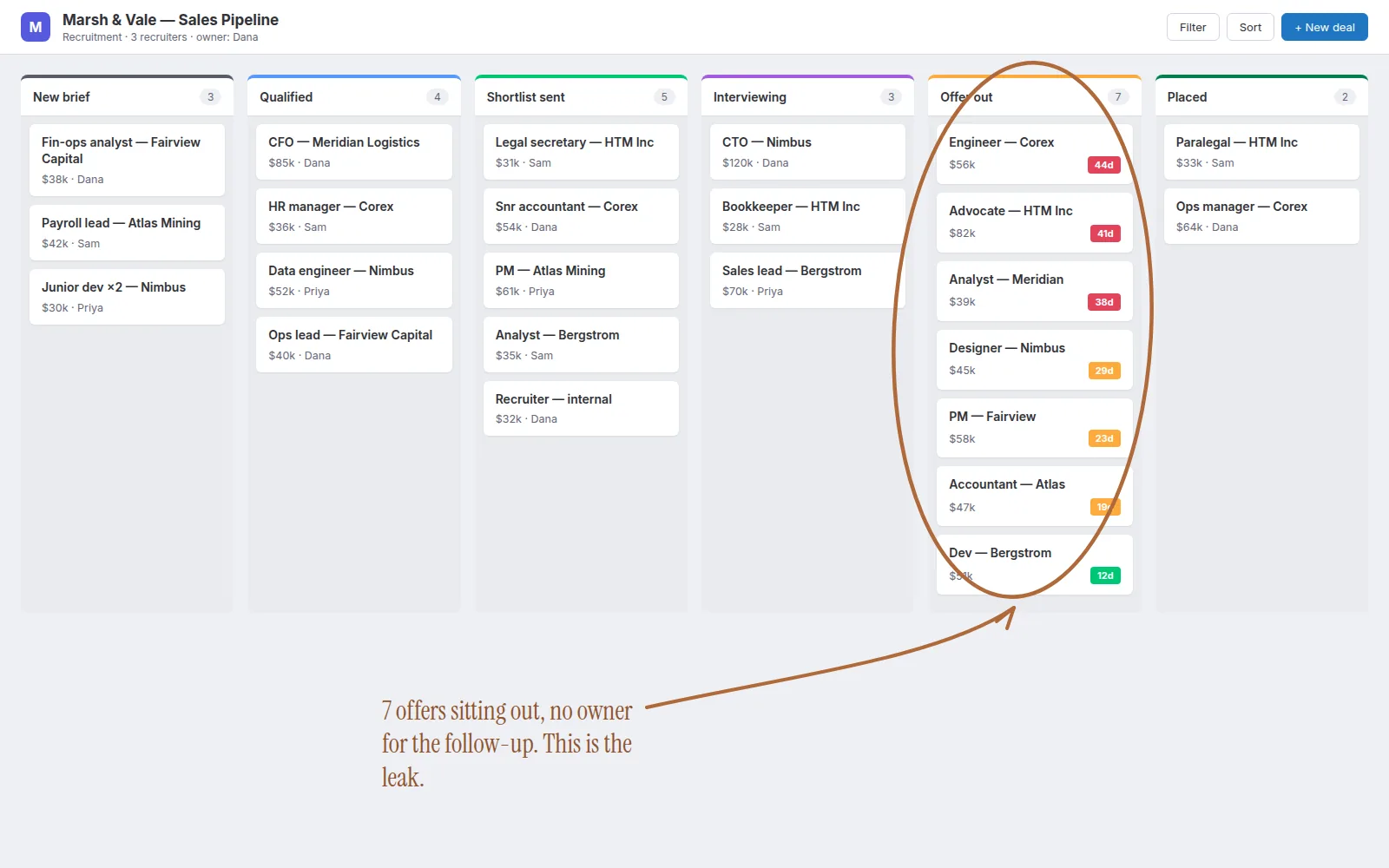
The founder wanted to talk about lead flow. Every agency owner I meet does. The top of the pipeline is rarely where the money is going, so I asked for two counts instead: how many offers are out right now, and how many days each one has been out. Then who owns the next touch on each.
The answer was seven offers out, ageing from twelve to forty-four days, and not one of them owned by a named person. Every one had already been paid for, in sourcing, screening and the client’s time in interviews, and was dying in the week nobody had been given. Robert Half’s number for how long a candidate waits before losing interest is ten business days. The youngest of those seven was at twelve.
That is not a motivation problem. Nobody had decided whose job the week after an offer was, so it became nobody’s. That’s where the first fortnight went, and it is the cheapest revenue in any agency.
Seven offers out, ageing from twelve to forty-four days, and not one of them owned.
Evidence on every stage. A name on every offer. The method on paper.
- 01
Stages that measure evidence, not enthusiasm
Each stage got an entry condition the client has to supply: the role, the rate and the interview slots in writing before a brief is live; a confirmed diary slot before it is at interview; a signed acceptance before it is a placement. The board got shorter and truer in the same week, and the forecast stopped being an argument.
- 02
Two pipelines that meet in the middle
The ATS was doing the candidate side well, so it kept doing it. The client side (briefs taken, offers out, repeat business) was the half living in email and memory, and that is the half that got built, beside the ATS rather than instead of it. Both pipelines carry the same two fields on every record: an owner, and a next step with a date. Almost everything else follows from those two fields existing and being reviewed once a week.
- 03
A cadence on every offer out
Day 0, the offer goes out the same day the client confirms. Day 2, the decision call. Day 5, the counter-offer check. Day 7, close or close out. Scripted, owned, dated, and reviewed on one screen every week alongside brief-to-placement time and repeat briefs per client. The seven unowned offers went to zero in the first fortnight, and stayed there.
- 04
The founder’s method stopped being in the founder
She closed at a rate the market would envy and had never had to explain how. So the method became a playbook: how this agency wins work, in the order it happens, with the language that works and the evidence each step needs. Not a manual nobody opens; the actual sequence, runnable by someone in week one instead of reverse-engineered over a quarter.
- 05
Then they made me run the team on it
Which is the part I learned the most from. The founder promoted me to run the team that had to use the system, and I sat with them on their own live deals until running it was easier than not running it. A system nobody uses is a document. Adoption is not a phase at the end of the build; it is the build.
The numbers are the client’s own.
| Measure | Before | After |
|---|---|---|
| Pitch to placement | 16% | 30%+ |
| New consultant’s first placement | 3 months | 1 month |
| Placements per month | 6 | 35+ |
| First contact to placement | 90 days | 46 days |
| Offers out with no owner | 7 | 0 |
| Quota attainment | not measured | 85% |
The part I’m proudest of
The hire that came after the build inherited a process instead of a head. First placement in month one, on a playbook she could read, with a board that told her what to do next. That’s the difference between a firm that has a great recruiter and a firm that has a way of recruiting.
From someone who worked inside it
Through her meticulously detailed lead tracker, custom insight reporting, and dynamic metrics, she brought complete clarity to complex data while constantly updating processes to account for shifts in the market and client needs.
From day one, she created an environment where questions were welcomed, continuous learning was part of the culture, and ownership was actively encouraged.
Count the offers on day one.
I spent the first fortnight finding out what the offer count was. On every build since, it’s the first question on the first call, before the tool, before the stages, before the lead flow. Two numbers: how many offers are out, and how many have a name against the next touch. It tells me more about an agency in five minutes than a quarter of pipeline data does.
The other thing: quota attainment wasn’t measured before the build, so 85% is a number with no before. I’d put it on the board in week one now, even at one consultant, so the after has something to stand against.
The research says the same thing, with a number on it.
None of what follows is my data. It’s why I looked where I looked, and why I’d expect the same shape in your agency.
A formal process is worth 18%
Vantage Point Performance and the Sales Management Association studied B2B companies and found an 18% difference in revenue growth between the ones with a formal sales process and the ones without. Harvard Business Review published it in 2015. “Formal” means exactly what this build made: stages defined, entry evidence agreed, and a manager actually holding the line on both. The same research found the overwhelming majority of top-performing sales organisations run a guided, structured process. Which is the polite way of saying what this case says bluntly: a close rate that lives in one person’s head is a personal talent, not a business asset. It can’t be taught, reviewed or forecast, only envied, and eventually lost.
The offer is the expensive stage
Ashby’s analysis of 230,000 offers puts candidates who accept at about two days in the offer stage and candidates who decline at about six. Robert Half found 62% of candidates lose interest if they haven’t heard back within ten business days. Gartner has offer acceptance at 48% in late 2025, down from 85% two years earlier. The market got harder, and every one of those numbers says the same thing about the days an offer sits unowned: they are the days a counter-offer gets cheaper.
The method leaves with the recruiter
Recruiterflow’s guide to recruiter onboarding says it plainly: informal training leaves with the best recruiter. The playbook is the founder’s method written down before the second consultant starts, not after the first one leaves.
Voices recruiters already listen to
You assume that an offer, once accepted, is a done deal. It’s not.Greg Savage · The Savage TruthThen “accepted” is a stage with an owner and three more touches, not the finish line.On the board: “accepted” carries an owner and a dated next touch until the start date.
Making an offer that will be accepted is not an event. It’s not a conversation. It’s a progression.Greg Savage · The Savage TruthA progression has steps with dates. That is a cadence, and it belongs in the system, not in the consultant’s memory.On the board: day 0, 2, 5 and 7 on every live offer.
If you win an order, even fill a job, you don’t yet have a ‘client.’ That takes consistent and ongoing work.Greg Savage · The Savage TruthWhich is why the board needs a stage after “placed”.On the board: a stage after “placed”: day 30, day 90, next brief.
Many firms rely on their best recruiter training new hires informally. That works well — until that person is out, promoted, or leaves, and the training know-how leaves with them.RecruiterflowThe playbook is the founder’s method written down before the second consultant starts, not after the first one leaves.On the board: the playbook is the onboarding path; a new consultant runs it in week one.
Jordan & Kelly, “Companies with a Formal Sales Process Generate More Revenue”, HBR (2015) · Vantage Point Performance & Sales Management Association · Ashby, Talent Trends: Offer Acceptance Rates (2023) · Robert Half, “How to lose a candidate in 10 business days” (2021) · Gartner, June 2026 · Recruiterflow, “Recruiter onboarding & ramp” (2026) · Greg Savage, “18 ways you screw up placements” (2025), “Can you counter the counteroffer?” (2022), “2 out of 5 clients will dump you” (2024)
Your last ninety days of briefs and offers, mapped stage by stage.
This build started with two counts: offers out, and offers owned. What came out of it was stages that ask the client for evidence, and one screen reviewed every week with brief-to-placement time on it. Both are fixes on the menu now, each at a flat price: Reset my stages and Build my dashboard. The call confirms the cause; it can’t raise a listed price.
Reset my stages · Build my dashboard
$750 + $1,500 · cheaper built together
Put these fixes on my sheetThe founder’s method, written so week one is week one.
$2,150 · built before the second consultant starts
Build our playbook →Your last ninety days of briefs and offers, by stage and by age, in seven days.
$1,550 · goes toward the fixes you start inside 30 days
Find the leak →Not sure yet? Start with the cadence.
The offer-out cadence and the audit sheet are free on the recruitment page for your first name and email. Fill in the sheet, send me the number of offers with no owner, and I’ll tell you what it says.
If you have no briefs coming in at all, the problem is demand, not process, and I’m the wrong first call. If you run pure high-volume temp with a fully automated ATS and no client-side selling, there may not be a pipeline problem worth paying me to solve.
// The numbers are the client’s own.
Nothing broken. Nothing built.
If that line describes your agency, the first call is free, and I’ll tell you where I think it’s leaking whether or not you ever work with me.